 |
 |
 |
 |
 |
 |
 |
 |
 |
 |
 |
 |
 |
 |
 |
 |
 |
 |
|
Gallery 4 The
Tibetan Photo Project has received a donation of photos in the
form of original negatives from an expedition into Tibet. These
rare
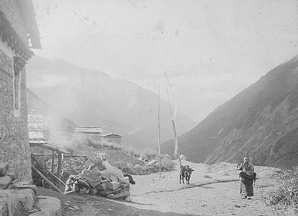
1932 photos provide glimpse of Tibet before China's invasion
By Joe Mickey & Sazzy Lee Varga Cofounders of the Tibetan Photo Project
Click
film strip to go to Gallery index page.
|
The Chinese invasion of Tibet began in 1949 and over the last 50 years all but 13 of Tibet's 6,000 monasteries have been destroyed. Some were used for firing practice by Chinese tanks while the monks were still inside. The Chinese invasion of Tibet began in 1949 and over the last 50 years all but 13 of Tibet's 6,000 monasteries have been destroyed. Some were used for firing practice by Chinese tanks while the monks were still inside.
|
|
In all it is estimated that 1.2 million of the six million Tibetan population have died since the Chinese invasion by means of murder, execution, torture, starvation and forced labor. Today China celebrates the "peaceful liberation" of Tibet while it still carts religious leaders off to prison or as the Chinese official explanation often terms it, military hospitals for "reeducation" on the post 9/11 excuse that any dissension is now labeled terrorism. In Tibet, China continues to tear down remote Buddhist enclaves, while it promotes a sort of Tibetan Buddhist Disneyland designed to capture tourist dollars. Many of these dollars will no doubt help fund the prisons that hold monks and nuns. Many of these dollars will fund ChinaÕs plans expand its military technology. In 1932, Tibet belonged to the Tibetans. Its remoteness made it a mystical place. Western visits were rare and the process of relaying information often grew in the time it took to travel west into fantastic stories of men who could fly across mountains or advanced spiritual beings who could levitate. |
Click image to enlarge |
|
|
As the truth about Tibet emerged, what was learned was that Tibet was made up of hardy people and had also developed a unique interpretation of the teachings of Buddha. While the rest of the world was defining itself externally with bigger and better machines and weapons, the Tibetan Buddhists had devoted their efforts to advancement the definition and purpose of life by developing inwards. At the top, the position of the Dalai Lama was revered and it held all the human intrigue that hierarchies are bound to possess. Nevertheless, much of what made Tibet unique in the world was built on the mystical practices, divination's and in the vast remoteness and great mountain ranges,Tibetans came to know and understand the array of spiritual deities that defined their rules of existence. In 1932, the world was not fully mapped and a team of western mountain climbers went on a nine month expedition through China to the Chinese -Tibetan Border to find a mountain that many believed might be taller than Everest. Richard Burdsall, Arthur Emmons, Terris Moore and Jack Young sought to locate, and if possible, climb Mount Minya Konka. In 2000, after meeting a group of Tibetan Monks and being introduced to a sponsorship program for monks living in exile in southern India. As a photographer, we began sending cameras to the monks and requested glimpses of their daily lives. |
Click image to enlarge |
|
|
The project grew into the Tibetan Photo Project and after early press by San Francisco Chronicle Art Critic Kenneth Baker, we were contacted by Kathryn Smathers who said she had some negatives from her father's 1932 mountain climbing expedition and there were pictures of Tibet. Would we be interested? Notes from Joe Mickey. The photo project is funded on my not-so-large salary, and while honored by the offer, I felt we were not worthy and told Smathers that such wonderful photos really needed a better home, but she was insistent that they belonged with the Tibetan Photo Project and a few days later they arrived in my mail box. I had expected to receive prints but what we got instead were about 30 original negatives from the expedition that went in search of a mountain higher than Everest. A search of the Internet revealed that a book on the adventure had been written by the climbers and while out of print since 1989, was readily available, for a price. "Men Against the Clouds" details the effort and the assent of Minya Konka. It is not higher than Everest, but their assent of the 24,900 foot peak set an American altitude record that stood for 25 years. Before you rush out to buy your copy of "Men Against the Clouds" a word of warning - it is not a literary masterpiece of adventure. It is a dry, matter-of-fact telling of the story that includes the harrowing moments you would expect from such an uncharted adventure. In looking at the photos and having my own feelings about the importance of Tibet to the remnants of heart and soul of the of the human race, I had hoped on reading the book to discover great spiritual awakenings among the Americans due to their contact with the Tibetans. |
Click image to enlarge
|
|
This is not the case. The world was a different place in 1932 and to find spiritual awakening you have to be looking for it. Or as a young Lama I once interviewed told me, "In order to find the path to truth, you have to leave the life you are now living and go and study." The American mountaineering expedition was not on a spiritual search. Their efforts proved to be more of a military exercise as they made their attacks and assaults against the enemy of elements that surrounded the mountain. When it was said and done, the Americans felt they had conquered the mountain and they were battered, injured and bruised and bandaged for the effort when they claimed victory. What the Americans did note about the Tibetans is that more than once Tibetan guides and nomads along the way insured their survival because of the TibetansÕ knowledge for living and coexisting with, instead of against, the mountain gods. On rare occasions the Westerners acknowledged that they were traveling sacred ground. Struggling at 23,000 feet there was a moment when they felt a kinship with birds that lived at that altitude but, at least from the book, there is an attitude of American superiority to both the Tibetans and the Chinese. Tibetans know how to survive a night outside in a blizzard as a matter of daily travel and routine. These Americans treated it all as an elongated visit that should have had better solutions. It took time for it to dawn on them that the Tibetans were by the far the masters in the environment simply because they coexisted with the environment through a spiritual knowledge of the terrain. |
Click image to enlarge |
|
|
They knew how to read the voices of the gods in the thunder and the deities in the lightening storms and the voices of 100- mile-per-hour mountain winds. While the American climbers of Minya Konka only had brief visions of the spiritual lessons of Tibet, the experience traveled with them their entire lives, the way things do when they touch the heart and if there is one... the soul. The Americans captured glimpses on film of unique people that lived in another world The photographic images, while they may not show an understanding of their subject, there is not doubt that the Americans came to respect the Tibetans. Even then, Tibet forced them to look deeper into themselves. It is that ability that Tibet still can hold for the world if the Chinese would let it be what it is supposed to be. China offers a great deal of technological advancement , the development of transportation and perhaps more creature comforts to Tibet. The problem is that China, like the Americans who climbed Mount Minya Konka, see a need to conquer and to rule over Tibet, instead of allowing it to be a place of majesty where the human soul soars, touches and hears the gods of all religions. If the Chinese rule continues on its current path, the human race knows how this story will end. Europeans and the new Americans destroyed the Indians. Australia nearly annihilated the Aborigines and all they have to offer. White minority rule created utter desecration of the human condition in south Africa before its defeat created a hero for the world. People increasingly look to the external for satisfaction. Solutions to a growing number of problems are believed to be at hand with faster computers, smarter weapons and more money. Saving Tibet will be the last chance the world has to save itself from a place that matters most Ñ To be saved from the heart and soul. |
Click image to enlarge |
|
The Tibetan Photo Project note: The following is a post script by Katrina Smathers. Smathers kindly donated the 1932 Photos to The Tibetan Photo Project following an article by San Francisco Chronicle Art Critic Kenneth Baker on The Tibetan Photo Project in 2003. Audience with the Dalai Lama , New York City, May 5, 2009, Katrina Smathers After my father’s death, my mother unknowingly discarded the actual photographic negatives of Tibet as she prepared to move to a retirement home. Amazingly, they were rescued by a neighbor hauling out the trash who passed them on to me. I had a CD made to preserve the photographs for the family and then wondered what to do with the actual negatives. Time passed, the negatives languished, but on a trip with Dave, browsing in a bookstore in Mendocino, I saw an announcement that local photographer Joe Mickey was putting together an exhibit on Tibet prior to its takeover by the Chinese in 1950. Acting on a whim, I e-mailed him offering him the negatives, which he gratefully accepted and incorporated some of them into his Tibetan Photo Project, an exhibit that has circulated in widely in the US. In recent years all this went to the back of my mind, but in early April this year I received an e-mail from Joe forwarding to me an e-mail from one Roger Croston in England seeking information on Americans and Canadians who had traveled in Tibet prior to 1950. Again acting on a whim, I responded to Mr. Croston, telling him of my father’s expedition. He responded that he was familiar with it, and invited me to the event he was organizing, an “audience” with the Dalai Lama for pre 1950 travelers and (since they would be deceased or very elderly) their descendants, modeled on a similar event held in Oxford last summer for British travelers and descendants. I was overjoyed at the enthusiasm of my daughter Mary when I shared this news. She efficiently made arrangements, and we set out for New York City, leaving SFO at 6:30 am May 4 on a Delta non-stop to JFK airport. Mr. Croston had suggested that we bring items from old Tibet to present to His Holiness. Our choice was a stone with a carved prayer on it (that garnered us some attention from airport security!) and a photograph of a huge Buddha, nicely enlarged, printed and framed by my friend Pat McQuade. An easy bus ride then brought us to Grand Central Station, a thrill to see, neither of us having been in New York for years (a great many years in my case!). Our nearby hotel was in walking distance from the Waldorf-Astoria, the site of the event which we had been told we must keep confidential beforehand, (that was fun, teasing my friends with the mystery). We had a delightful Indian dinner and an early bedtime, and then proceeded the next morning, as instructed, to the Waldorf’s 18th floor where security was in evidence. Our host-organizer Roger Croston, in classic British accent, announced “His Holiness will enter in two minutes” and he did, looking exactly like his pictures, flanked by a group of six or so aides, Asian men in business suits (one we later talked to had worked for the Dalai Lama for 25 years). The Dalai Lama’s speech, for perhaps 20 minutes, was definitely political rather than spiritual. He has been the force behind an immense public relations campaign for the Tibetan Government in Exile for the last 50 years; this event was clearly part of that effort. He spoke, (in rather inarticulate English, sometimes helped by a staff member) of his consistent efforts to gain respect and consideration from the Chinese conquerors. He made clear his belief in persistence, always defined by calmness, positive optimism, lack of vengeance, refusal to be defeated, while recognizing that a military effort, throwing the Chinese out, would be impossible. I was glad that I’d just read his autobiography, which so vividly describes his lifework, starting as a youth of fifteen, then fleeing Tibet to set up the government in exile and the refugee settlements, nine years later. To me, his devotion to his people and their welfare forms an impressive backdrop to his spiritual insights. We then were directed to form a circle behind him, in our groups, and come forward for a minute (time was carefully monitored, his entire presence was clearly limited to one hour total). Mary, Julia, and I grasped his hands (not quite hand-shaking, not bowing either) at which time a picture was taken (only official photography was permitted), we presented the prayer stone in its labeled box, the framed Buddha photograph, and a copy of the book about the expedition. He said “thank you”, aides immediately took the items, and we moved on, all literally in about one minute. When everyone had completed this process, the entire group was assembled behind him for an official group portrait, Roger Croston proclaimed “This meeting is now over” and the Dalai Lama swept out with his entourage. Mary and I went to lunch with Julia Emmons, an interesting person a few years younger than me (former history professor and then manager of a track club in Atlanta) who had actually, with her sister, gone to the Minya Konka area (traveling with a guide) and retraced our fathers’ steps up to their base camp. In e-mail since, she and I have agreed that it’s like discovering a cousin you didn’t know (her father died in his fifties and I never met him). After her departure, Mary and I had a New York afternoon (Metropolitan Art Museum, Guggenheim Museum, taste of Central Park) and then Mary’s incredible birthday treat to me: dinner and a Broadway show “Wicked”, followed by a walk back to our hotel, and a smooth trip home the next day. |
||
To learn more and to help Tibet, click on connect with Tibet. |
Archive Notice: The Tibetan Photo Project website contains more than two decades of historical material. Some pages are preserved as part of the project archive and may include older dates, links, projects, technology, fundraising information or references that are no longer current. All images are Copyright 2001-2026, Joe Mickey / Estate of Joe Mickey (Connie Korbel-Mickey), and The Tibetan Photo Project and may not be published without permission. You are welcome to print material from this site for personal reading or to share privately with friends. For feature articles, publication, educational use, exhibitions, or other public use of photographs or material from this site, please contact The Tibetan Photo Project at tibetanphoto@gmail.comuse of any of the material or images contained on this site please contact Joe Mickey via e-mail at tibetanphoto@gmail.com and please reference your e-mail to the Tibetan Photo Project. Thank You.
|
|